

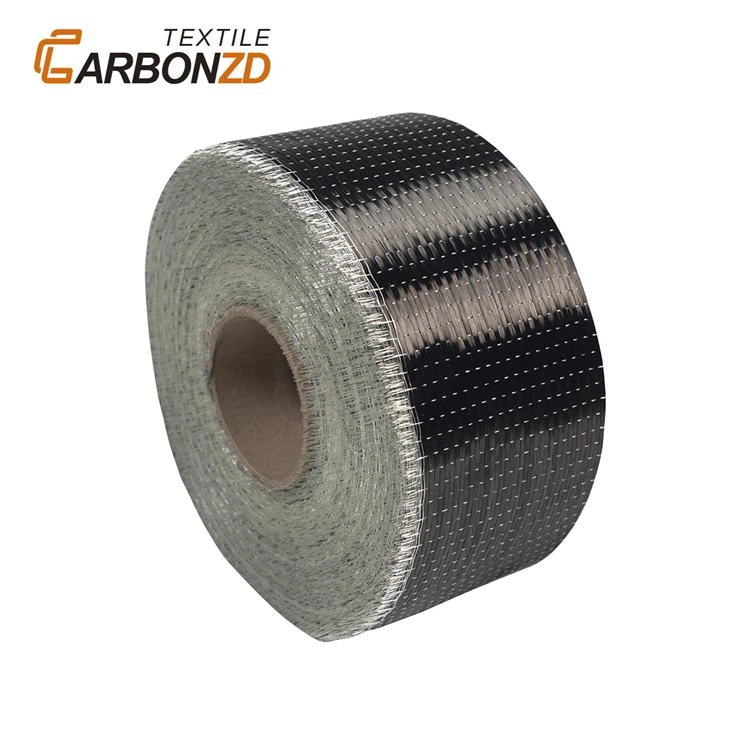
As a supplier of UD (Unidirectional) Carbon Fiber Fabric, I often encounter inquiries about the fiber volume fraction of our products. This crucial parameter significantly impacts the performance and application of UD carbon fiber fabric, and understanding it is essential for both manufacturers and end - users.
What is Fiber Volume Fraction?
The fiber volume fraction (Vf) refers to the proportion of the volume of carbon fibers in the total volume of the composite material that includes the fibers and the matrix (usually a resin). It is expressed as a percentage. For example, if a UD carbon fiber fabric composite has a fiber volume fraction of 60%, it means that 60% of the total volume of the composite is occupied by carbon fibers, while the remaining 40% is the resin matrix.
The fiber volume fraction is a key determinant of the mechanical properties of UD carbon fiber fabric composites. A higher fiber volume fraction generally leads to better mechanical performance, such as increased strength, stiffness, and fatigue resistance. This is because carbon fibers are extremely strong and stiff compared to the resin matrix. However, achieving a very high fiber volume fraction can be challenging due to processing limitations.
Measuring the Fiber Volume Fraction
There are several methods to measure the fiber volume fraction of UD carbon fiber fabric. One common approach is the burn - off method. In this method, a sample of the composite is weighed, and then it is heated in a furnace at a high temperature (usually around 500 - 600°C) to burn off the resin matrix. After the resin is completely burned, the remaining carbon fibers are weighed again. The fiber volume fraction can be calculated using the following formula:

[V_f=\frac{W_f/\rho_f}{W_f/\rho_f + W_m/\rho_m}]
where (W_f) is the weight of the fibers, (\rho_f) is the density of the carbon fibers, (W_m) is the weight of the matrix, and (\rho_m) is the density of the matrix.
Another method is the acid digestion method. In this process, the composite sample is immersed in a strong acid that can dissolve the resin matrix without affecting the carbon fibers. After the resin is dissolved, the fibers are separated, dried, and weighed. Similar to the burn - off method, the fiber volume fraction can be calculated based on the weights and densities of the fibers and the matrix.
Factors Affecting the Fiber Volume Fraction
Manufacturing Process
The manufacturing process of UD carbon fiber fabric has a significant impact on the fiber volume fraction. For example, in the hand - lay - up process, it is relatively difficult to achieve a high fiber volume fraction because it is a manual process, and there may be more voids and uneven resin distribution. On the other hand, processes like resin transfer molding (RTM) and autoclave molding can achieve higher fiber volume fractions. In RTM, the resin is injected into a mold containing pre - placed carbon fibers under pressure, which helps to displace air and ensure a more uniform resin distribution. Autoclave molding applies both heat and pressure, which can further compact the fibers and reduce voids, resulting in a higher fiber volume fraction.
Fiber Architecture
The architecture of the carbon fibers in the UD fabric also affects the fiber volume fraction. In a well - aligned UD fabric, the fibers can be packed more densely, allowing for a higher fiber volume fraction. However, if the fibers are misaligned or have a lot of crimps, it becomes more difficult to achieve a high fiber volume fraction.
Resin Viscosity
The viscosity of the resin used in the composite is another important factor. A resin with high viscosity may not flow easily between the carbon fibers, leading to incomplete impregnation and a lower fiber volume fraction. Low - viscosity resins are generally preferred as they can better penetrate the fiber bundles, resulting in a more uniform distribution of the resin and a higher achievable fiber volume fraction.
Importance of Fiber Volume Fraction in Different Applications
Aerospace Industry
In the aerospace industry, UD carbon fiber fabric composites with a high fiber volume fraction are highly sought after. Components such as aircraft wings and fuselages require materials with high strength - to - weight and stiffness - to - weight ratios. A higher fiber volume fraction means that more of the load - bearing carbon fibers are present in the composite, which can significantly improve the mechanical performance of the aerospace components. This, in turn, helps to reduce the weight of the aircraft, leading to lower fuel consumption and increased efficiency.
Automotive Industry
In the automotive industry, UD carbon fiber fabric is used for manufacturing high - performance parts such as body panels, chassis components, and driveshafts. A higher fiber volume fraction can enhance the strength and stiffness of these parts, improving the overall performance and safety of the vehicle. Additionally, the lightweight nature of carbon fiber composites with a high fiber volume fraction can contribute to better fuel economy and faster acceleration.
Civil Engineering
In civil engineering, UD carbon fiber fabric is often used for strengthening existing structures. For example, Carbon Wrapping for Beams is a common application. The fiber volume fraction of the carbon fiber fabric used in these applications affects its load - carrying capacity. A higher fiber volume fraction can provide greater reinforcement to the beams, increasing their strength and durability.
Our UD Carbon Fiber Fabric Products and Fiber Volume Fraction
At our company, we offer a range of UD carbon fiber fabric products with different fiber volume fractions to meet the diverse needs of our customers. Our 300g UD Carbon Fiber Fabric is a popular choice. It has been carefully engineered to achieve an optimal fiber volume fraction, which provides a good balance between mechanical performance and ease of processing.
We use advanced manufacturing techniques to ensure consistent fiber volume fractions in our products. Our quality control team conducts regular inspections using the methods mentioned above to guarantee that the fiber volume fraction of each batch of UD carbon fiber fabric meets our high - quality standards.
For more information about our CFRP Carbon products and their fiber volume fractions, you can visit our website. We are committed to providing our customers with high - quality UD carbon fiber fabric that meets their specific requirements.
Contact Us for Procurement
If you are interested in our UD carbon fiber fabric products and would like to discuss your procurement needs, we encourage you to reach out to us. Our experienced sales team is ready to provide you with detailed product information, technical support, and competitive pricing. Whether you are in the aerospace, automotive, civil engineering, or any other industry that requires high - performance carbon fiber composites, we can work with you to find the best solution.
References
- Callister, W. D., & Rethwisch, D. G. (2011). Materials Science and Engineering: An Introduction. Wiley.
- Agarwal, B. D., Broutman, L. J., & Chandrashekhara, K. (2006). Analysis and Performance of Fiber Composites. Wiley.
- Hull, D., & Clyne, T. W. (1996). An Introduction to Composite Materials. Cambridge University Press.