

Hey there! As a supplier of UD carbon fiber fabric, I often get asked all sorts of questions about our products. One question that's been popping up a lot lately is, "Is UD carbon fiber fabric resistant to radiation?" Well, let's dive right into it and find out.
First off, let's understand what UD carbon fiber fabric is. UD stands for unidirectional, which means the carbon fibers in the fabric are aligned in one direction. This gives the fabric excellent strength and stiffness in that particular direction. It's used in a wide range of applications, from aerospace and automotive industries to sports equipment and construction. For instance, you can check out Carbon Reinforced Polymer to see some of its applications.
Now, when it comes to radiation resistance, we need to look at different types of radiation. There are several kinds, such as electromagnetic radiation (like radio waves, microwaves, infrared, visible light, ultraviolet, X - rays, and gamma rays) and particle radiation (such as alpha particles, beta particles, and neutrons).
Let's start with electromagnetic radiation. Carbon fiber itself is a good conductor of electricity. This property gives it some level of protection against electromagnetic radiation, especially in the lower frequency ranges. When an electromagnetic wave hits the carbon fiber fabric, the free electrons in the carbon fibers can interact with the electric field of the wave. This interaction can cause the wave to be reflected, absorbed, or scattered.
For example, in the case of radio waves and microwaves, UD carbon fiber fabric can act as a kind of shield. The conductivity of the carbon fibers allows them to create an induced current when exposed to the electromagnetic field of these waves. This induced current then generates its own electromagnetic field that opposes the incident field, reducing the amount of radiation that passes through the fabric.
However, as we move to higher frequencies like X - rays and gamma rays, things get a bit more complicated. Carbon has a relatively low atomic number (Z = 6), which means it's not very effective at stopping high - energy electromagnetic radiation. X - rays and gamma rays have enough energy to penetrate through the carbon fibers with relative ease. The probability of interaction between these high - energy photons and the carbon atoms in the fabric is quite low compared to heavier elements. So, UD carbon fiber fabric is not a great shield for X - rays and gamma rays.
Now, let's talk about particle radiation. Alpha particles are relatively large and heavy, consisting of two protons and two neutrons. They have a positive charge. UD carbon fiber fabric can stop alpha particles quite effectively. The fabric has enough density and structure to block these relatively large particles. When an alpha particle hits the carbon fiber fabric, it collides with the carbon atoms in the fibers, losing its energy in the process and eventually being stopped.
Beta particles are much smaller and lighter, either electrons or positrons. They are more penetrating than alpha particles. UD carbon fiber fabric can provide some protection against beta particles, but it may not completely stop them. The interaction between beta particles and carbon fibers is mainly through ionization and scattering. The beta particles can ionize the carbon atoms in the fabric as they pass through, losing energy in the process. But depending on the energy of the beta particles, some of them may still be able to penetrate the fabric.
Neutron radiation is another story. Neutrons have no charge, which makes them very difficult to stop. They interact with matter mainly through nuclear reactions. Since carbon has a relatively low cross - section for neutron capture, UD carbon fiber fabric is not very effective at stopping neutrons. Heavier elements with higher neutron capture cross - sections are usually needed to shield against neutron radiation.

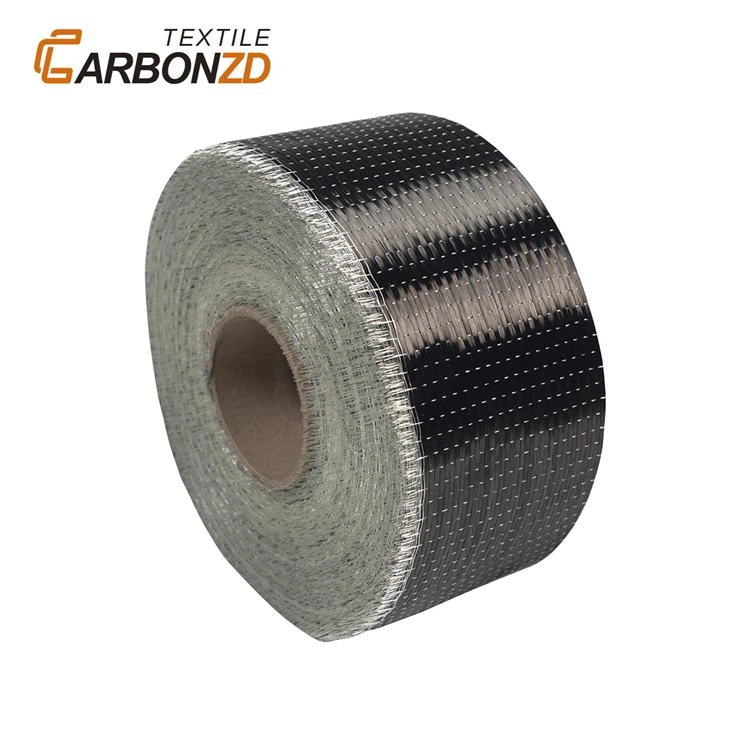
In practical applications, the effectiveness of UD carbon fiber fabric as a radiation shield also depends on the thickness of the fabric. A thicker layer of UD carbon fiber fabric will generally provide better protection against radiation than a thinner one. For example, a 300g Unidirectional Carbon Fiber Wrap may offer more protection than a lighter - weight version.
In the construction industry, where UD carbon fiber fabric is often used for strengthening structures like beams, the radiation resistance aspect is not usually the primary concern. However, in some special environments where there is a small amount of electromagnetic radiation, the fabric's properties can be an added bonus. You can learn more about its use in construction, like Carbon Wrapping for Beams.
It's important to note that while UD carbon fiber fabric has some radiation - resistant properties, it may not be suitable as a sole radiation shield in high - radiation environments. In such cases, it can be combined with other materials that are better at stopping specific types of radiation. For example, for protecting against X - rays and gamma rays, materials with high atomic numbers like lead can be used in conjunction with UD carbon fiber fabric.
So, to sum it up, UD carbon fiber fabric has some level of resistance to certain types of radiation, especially electromagnetic radiation in the lower frequency ranges and particle radiation like alpha particles. But its effectiveness varies depending on the type and energy of the radiation, as well as the thickness of the fabric.
If you're in an industry where radiation protection is a concern and you think UD carbon fiber fabric could be part of the solution, or if you're just looking for high - quality UD carbon fiber fabric for other applications, I'd love to talk to you. Whether you need it for aerospace, automotive, sports, or construction, we've got a wide range of UD carbon fiber fabric products to meet your needs. Don't hesitate to reach out and start a conversation about your requirements. We can work together to find the best solution for you.
References:
- "Introduction to Radiation Protection" by John E. Turner
- "Carbon Fiber Composites" by David Hull and T. W. Clyne